


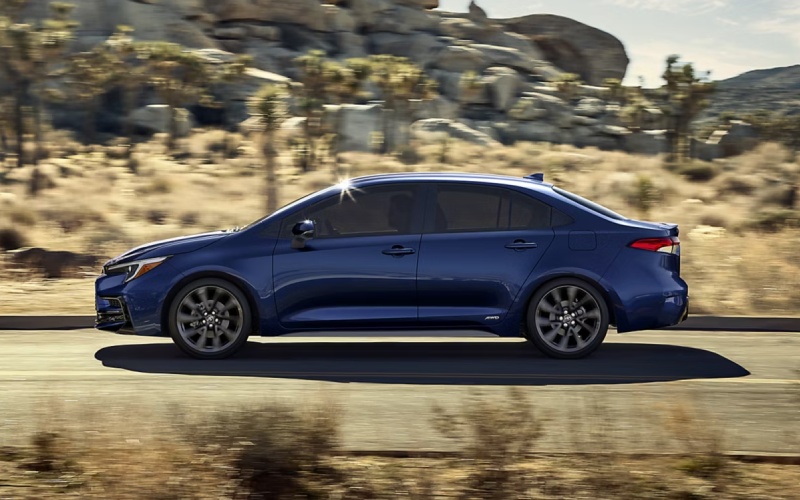
Venice Toyota – 2026 Toyota Corolla or 2026 Nissan Sentra: Which compact sedan delivers better driver-assist confidence for I-75 commutes around Bradenton, FL?
For many Gulf Coast commuters, a compact sedan lives in the fast lane during the week and cruises to coastal errands on the weekend. That reality puts driver-assist confidence near the top of the shopping list, which is why so many shoppers ask a straightforward question: between the 2026 Toyota Corolla and the 2026 Nissan Sentra, which one helps reduce fatigue and stress in stop-and-go traffic on I-75 around Bradenton, FL? Both models bring impressive tech, but the key differences shape how reliably those features serve you on the busiest days.
Start with the Toyota side. Every Corolla includes Toyota Safety Sense™ 3.0, which bundles Full-Speed Range Dynamic Radar Cruise Control, Lane Tracing Assist, Lane Departure Alert with Steering Assist, Pre-Collision System with Pedestrian Detection, Automatic High Beams, and Road Sign Assist. The benefit is consistency—no need to hunt for a certain trim to get core tools for highway guidance and speed modulation. The system’s tuning feels intuitive, with smooth acceleration and deceleration, predictable lane centering, and clear communication in the instrument cluster. Add the available 12.3-in. digital gauge cluster and 10.5-in. Toyota Audio Multimedia touchscreen, and the information layer becomes easy to read at a glance, helping attention stay on the road.
Sentra brings a competitive answer with available ProPILOT Assist, which coordinates steering assist and adaptive cruise for calmer freeway driving. In real-world use, ProPILOT Assist can meaningfully reduce the mental load during longer commutes, and the Sentra’s available “monolith” 12.3-inch dual displays put critical status updates front and center. The balance to consider is availability: you’ll typically need specific trims or packages to get the full feature set, and the rest of Sentra’s safety content varies by grade. If the plan is to shop once and know advanced assistance is included, Corolla’s standardization becomes a strong differentiator.
Confidence is more than the feature list—it’s how the car behaves when traffic patterns change suddenly. Corolla’s Full-Speed Range Dynamic Radar Cruise Control operates smoothly from highway speeds down to a crawl, and Lane Tracing Assist works with clear lane markings to support centered tracking on gentle curves. The Sentra’s ProPILOT Assist offers similar benefits, and many drivers appreciate how naturally it guides the car without feeling intrusive. Choose either system, and you’ll step up from conventional cruise control. Choose Corolla, and you know the system arrives standard across the lineup.
There’s also the question of traction and overall composure during quick weather changes or when paint markings are wet and reflective. Corolla Hybrid models offer available Electronic On-Demand All-Wheel Drive, which can direct power to the rear wheels when front grip is compromised. While AWD isn’t a substitute for attentive driving, it provides a broader envelope of stability when you ease onto an on-ramp with slick pavement. Sentra, by contrast, is front-wheel drive only. For many drivers, FWD is perfectly adequate. For those who want added traction assurance as part of their highway routine, Corolla retains a meaningful advantage.
Integrated tech matters, too. In both sedans, wireless Apple CarPlay® and Android Auto™ simplify hands-free calling and navigation prompts. Corolla’s available Drive Connect subscription adds Cloud Navigation and an Intelligent Assistant that accepts natural voice commands—useful when toggling routes after a traffic alert. Sentra’s NissanConnect® ecosystem offers remote features, a Wi-Fi Hotspot, and over-the-air capabilities; the available Bose Premium Audio System adds depth and clarity to podcasts and conference calls. Each car can fit modern life, yet Corolla’s seamless pairing with Toyota Safety Sense™ 3.0 creates a cohesive driver-assist and infotainment experience that many commuters prefer.
Powertrain choice influences long-term satisfaction. Corolla offers a responsive 2.0-liter gas model and a Hybrid lineup aimed at maximizing efficiency while maintaining a refined, quiet drive. That flexibility means drivers can prioritize range between fill-ups or stick with a traditional gas experience. Sentra uses a 2.0-liter engine with an Xtronic CVT; it’s tuned for easygoing drivability. If your commute involves long stretches behind variable-speed traffic, Corolla’s Hybrid smoothness can help keep the cabin calm, especially when paired with Full-Speed Range DRCC.
To help evaluate the details, here’s a quick framework that many shoppers find useful when comparing driver-assist confidence for regional commuting:
- System availability: Do the core highway assistance features come standard, or are they tied to specific trims and packages?
- Behavior in traffic: Are acceleration, braking, and lane guidance smooth and predictable across varying speeds?
- Display clarity: Are alerts and status cues easy to read on digital gauges and the center screen without stealing focus?
- Complementary features: Does the car offer additional tools—like available AWD, natural-voice assistants, or camera views—that support confidence when conditions change?
Apply this checklist, and the picture becomes clear. Corolla’s Toyota Safety Sense™ 3.0 standardization answers point one decisively. Its polished traffic behavior, aided by Full-Speed Range DRCC and Lane Tracing Assist, checks point two. The available 12.3-in. digital cluster and 10.5-in. touchscreen satisfy point three with excellent readability. And the availability of Electronic On-Demand AWD on Hybrid models, plus the Intelligent Assistant with Cloud Navigation, adds meaningful depth for point four. Sentra’s available ProPILOT Assist and dual 12.3-inch displays also perform well, yet requiring specific configurations to match that coverage is the key consideration.
If the primary goal is to cut through the stop-and-go grind with consistent assistance, Corolla sets the pace. Choosing the right compact sedan is ultimately about daily trust—how readily the car steps in to reduce stress without getting in the way. From well-tuned assistance to flexible powertrains, Corolla continues to deliver that trust in a compact package.
Venice Toyota proudly supports drivers with in-depth test drives that demonstrate exactly how these systems behave in real traffic. Our team is committed to straightforward, feature-focused guidance so every shopper understands what’s standard, what’s available, and how to tailor a build for a specific commute.
Frequently Asked Questions:
Does every Corolla include Toyota Safety Sense™ 3.0?
Yes. Toyota Safety Sense™ 3.0 is standard across the Corolla lineup, bringing advanced driver assistance to every trim.
Is Nissan’s ProPILOT Assist standard on all Sentra trims?
ProPILOT Assist is available on select Sentra trims. Availability can vary by package and configuration.
Which model offers all-wheel drive for added traction?
Corolla Hybrid offers available Electronic On-Demand AWD. Sentra is front-wheel drive only.
Do both sedans support wireless Apple CarPlay® and Android Auto™?
Yes. Both Corolla and Sentra offer wireless Apple CarPlay® and Android Auto™ compatibility for convenient smartphone integration.
Can I try these driver-assist features during a test drive?
Absolutely. Ask for a demonstration drive that includes freeway segments to experience adaptive cruise and lane centering in typical traffic.
For a personalized walk-through of driver aids and infotainment—serving Bradenton, Nokomis, and North Port—schedule a visit and bring your daily routes to life with a side-by-side comparison. The more these systems are tailored to your routine, the more value they deliver over time.
Request more 2026 Toyota Corolla information
Connect with us


- 2024 4Runner
- 2024 Corolla
- 2024 Crown
- 2024 Grand Highlander
- 2024 Highlander Hybrid
- 2024 RAV4
- 2024 Sequoia
- 2024 Tacoma
- 2024 Tacoma Hybrid
- 2024 Toyota Lineup
- 2024 Tundra
- Toyota Camry
- Toyota Corolla
- Toyota Dealer
- Toyota Land Cruiser
- Toyota RAV4
- Toyota Service
- Toyota Tacoma
- Toyota Tundra
- Uncategorized
- Venice Toyota Dealer