


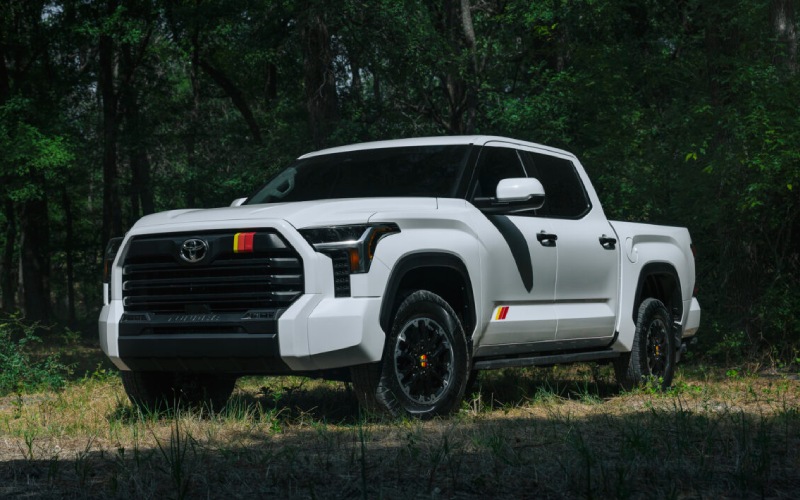
Venice Toyota – Does the 2026 Toyota Tundra or 2026 Ford F-150 offer better hybrid towing confidence around Nokomis, FL?
When truck shoppers ask which hybrid feels more confident towing a boat or work trailer around Nokomis, FL, the comparison usually zeroes in on two numbers: torque and control. Toyota’s i-FORCE MAX twin-turbo V6 hybrid lays down an impressive 437 hp and 583 lb.-ft. of torque, while Ford’s 3.5L PowerBoost Full Hybrid V6 delivers 420 hp and 570 lb.-ft. of torque. Those torque peaks are the reason you feel an immediate shove at launch, especially when the ramp is wet or the grade is steep. But confidence is more than a spec sheet. It is also how predictably a truck responds when weight shifts, crosswinds pick up, or the road gets broken and bumpy. That is where suspension tuning, frame stiffness, and trailer-assistance tech come together to make towing less of a workout.
Tundra pairs a fully boxed frame with a multi-link rear suspension and coil springs across the lineup to keep the rear axle planted and composed. The Ford F-150 uses a fully boxed frame as well, though most trims run leaf springs at the rear, with specialized models like Raptor using a five-link coil setup. Both trucks integrate tow/haul modes and an available Integrated Trailer Brake Controller, but Toyota goes heavy on intuitive camera and guidance tools. The available Panoramic View Monitor offers a 360-degree look at surroundings, and Tundra’s Trailer Backup Guide with Straight Path Assist helps keep the trailer tracking true while you focus on small steering inputs. Ford answers with Pro Trailer Backup Assist and a 360-Degree Camera. In practice, both systems reduce mental load; the Toyota approach prioritizes clear visual cues on an available 14-in. touchscreen that is easy to read at a glance.
Quick torque and real-world towing
On paper, Tundra’s hybrid torque advantage is small, but you feel it on the move. That extra twist, paired with a 10-speed automatic, makes short work of pulling into fast-moving traffic or easing a heavy trailer up an incline without constant downshifts. When properly equipped, Tundra’s max tow rating reaches up to 12,000 lb, aligning well with many boats, jobsite equipment, and family campers. Ford’s hybrid tows up to a listed 11,600 lb when properly configured. Both trucks do the job, but hybrid torque and the way it arrives through the driveline are central to keeping the driver relaxed while the truck stays composed.
Confidence also shows up when conditions get tricky. With a trailer, you are managing more than weight; you are managing inertia. Tundra’s coil-spring rear suspension helps absorb choppiness and reduces hobby-horsing that can fatigue drivers on long stretches. Add in the selectable drive and tow/haul modes, and you get throttle, shift, and braking behavior tuned for your load. The traction benefits are especially helpful when backing down a slick ramp or maneuvering on crowned, uneven surfaces.
Camera coverage and visibility that reduce stress
Backing a trailer is one of the top reasons shoppers ask for help comparing these two hybrids. Tundra’s available Panoramic View Monitor uses multiple cameras to deliver surround views, while Trailer Backup Guide with Straight Path Assist uses sensors and clear on-screen prompts to help keep the rig aligned. Ford’s 360-Degree Camera and Pro Trailer Backup Assist are similarly focused. Where the Toyota system stands out is the way views and prompts are organized on the available 14-in. screen, giving drivers an easy, intuitive workflow: quick checks, small corrections, less guesswork.
Visibility matters beyond reversing. The Tundra’s power vertical rear window that fully lowers helps drivers quickly see and communicate with spotters or adjust for long cargo. It is a small feature that many owners use daily, and it sets the Toyota apart. F-150’s sliding rear window provides ventilation, but the full drop of the Tundra’s glass is both practical and confidence-boosting when maneuvering in tight quarters.
Durability and the bed that can take a beating
Towing usually comes with cargo, which is why bed durability belongs in this hybrid discussion. Tundra’s aluminum-reinforced composite bed is standard and resists dents, dings, and rust. Over time, that translates to fewer repairs and less worry when loading tools, blocks, or wet gear. Ford’s aluminum bed is light and strong, but composite brings a unique advantage in shrugging off abrasion and corrosion—especially useful for coastal lifestyles and repeated dock visits.
Both trucks carry serious credibility off-road and in rough work environments. Toyota’s TRD Off-Road Package and TRD Pro trim bring hardware like TRD-tuned suspension with FOX® shocks and all-terrain tires for conditions beyond the pavement. Ford’s Tremor and Raptor answer with their own heavy-duty suspension and tire setups. Hybrids are increasingly part of this conversation, and Tundra’s i-FORCE MAX is engineered to balance electric assist and twin-turbo thrust in a way that feels seamless on- and off-road.
Which hybrid is the better tow partner?
For shoppers who prioritize strong low-end torque and a composed ride with a trailer in tow, Tundra’s i-FORCE MAX feels built for the task. Ford’s PowerBoost is a capable alternative, especially for buyers drawn to Ford’s available Pro Power Onboard feature for jobsite electricity. But if the core question is towing confidence—how the truck feels at launch, how it settles over broken pavement, and how quickly the driver can see and correct—Tundra’s torque, suspension tuning, and camera-guided backing flow give it an edge for many owners.
At the end of the day, either hybrid can be set up to meet your needs. The best move is to drive both on the same loop, with and without a trailer, and pay attention to the small moments: the way the steering settles, how often the transmission hunts, what the camera views show, and how smoothly you can back into a space. Those details are where confidence lives.
Frequently Asked Questions:
How much can the hybrid versions tow?
When properly equipped, the Tundra hybrid is rated up to 12,000 lb, and the F-150 hybrid is listed up to 11,600 lb. Actual capacity depends on configuration, payload, and equipment.
Do both trucks offer trailer backup assistance?
Yes. Tundra offers Trailer Backup Guide with Straight Path Assist, and F-150 offers Pro Trailer Backup Assist. Both aim to simplify reversing with a trailer by guiding your inputs.
Which truck feels more stable with a load?
Many drivers prefer the Tundra’s multi-link rear suspension with coil springs for its composed, settled feel over broken pavement. Test drives are the best way to judge which ride you prefer with a trailer attached.
Ready to compare hybrids head to head? Our team, serving Nokomis, North Port, and Port Charlotte, can help you test the features that matter most and answer detailed setup questions for your trailer, hitch, and common routes. Visit Venice Toyota to feel how each hybrid behaves with the kind of loads you move most.
Request more 2026 Toyota Tundra information
Connect with us


