


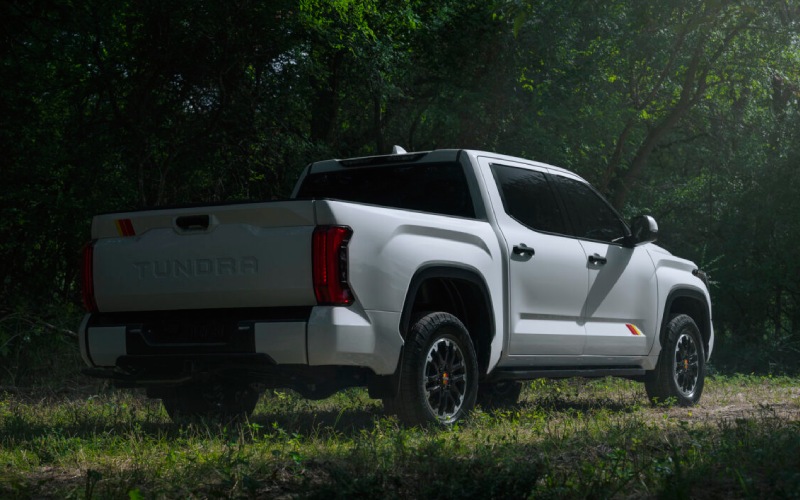
Venice Toyota – 2026 Toyota Tundra or 2026 Ford F-150 – Which full-size truck rides smoother on everyday roads around Port Charlotte, FL?
If you’re comparing ride comfort between two heavy hitters, the 2026 Toyota Tundra and the 2026 Ford F-150 make it a close race—at least on paper. But real-world comfort isn’t just about seat padding. It comes down to rear suspension design, chassis tuning, and how the truck settles after bumps, speed humps, and broken pavement you meet around Tamiami Trail or on your daily hop to the marina near Port Charlotte, FL.
The Tundra’s multi-link rear suspension with coil springs is a major differentiator. Coil-spring setups excel at controlling rebound and maintaining tire contact over uneven surfaces; that translates to less head toss and fewer secondary motions when you’re towing a small boat or cruising across patched asphalt. The F-150’s traditional leaf-spring rear remains durable under heavy payloads, but it tends to communicate more of the road directly into the cabin, especially when the bed is empty. If your daily drive includes frequent dips, bridge seams, and those worn intersections that seem to ripple after every summer storm repair, the Tundra’s composed response is easy to feel.
How suspension design shapes daily comfort
Beyond the spring type, geometry matters. The Tundra’s multi-link layout helps the axle track more precisely through its travel, which supports connected steering and predictable braking while towing. That control reduces the “see-saw” effect you sometimes feel with a trailer in low-speed traffic or when you’re jockeying into a tight driveway.
Ride quality isn’t just about softness; it’s about control. Squat under the throttle, nose-diving under braking, and how quickly the truck calms down after a bump all affect fatigue and confidence. The Tundra’s tuning aims for a calm recovery rather than simply dialing in a cushy initial hit, and that’s exactly what you notice when crossing uneven railroad tracks on the way to a launch.
Noise, vibration, and harshness
Comfort also lives in the background sounds and subtle tremors you may not think about until they’re gone. The Tundra’s frame and body isolation work alongside the multi-link rear to reduce the high-frequency chatter that can make long drives feel longer. While the F-150 isolates well too, the combination of coil springs and Tundra’s chassis tuning tamps down small, rapid impacts that otherwise sneak into the cabin as chatter or seat shake.
Even tire choice plays a role. Aggressive all-terrain patterns look great and help off-road, but they can introduce steady-state hum on concrete freeways. If your daily routes are mostly pavement with occasional sandy pull-outs, consider an all-season or mild A/T with a reinforced sidewall to complement Tundra’s suspension poise.
What about towing comfort?
Plenty of shoppers ask whether a smoother-riding truck can still feel stable with a trailer. The answer is yes—if the suspension geometry and damping are dialed in. The Tundra tows up to 12,000 lbs. when properly equipped, and its available Trailer Backup Guide with Straight Path Assist helps you line up confidently. The F-150 counters with strong maximums and its own trailer technologies, but Tundra’s composure when creeping on a slope or pivoting a trailer in close quarters stands out along the Gulf Coast, where space can be tight and visibility blocked by seawalls and landscaping.
On highways, active driver assists reduce fatigue, but camera systems and clear towing menus reduce mistakes—equally important for confident travel with family and gear. Here again, the Tundra’s user-friendly 14-in. touchscreen and accessible towing pages keep you on top of the situation without digging through submenus.
Quick checklist: how to test ride quality on your drive
Use a route that includes slow-speed turns, a few small bumps, a bridge seam, and a quick stop from moderate speed. Bring a cooler or a couple of toolboxes to simulate light real-world cargo. Toggle tow/haul and drive modes to feel how each truck manages throttle tip-in and downshifts. Most importantly, note how quickly the truck settles after a disturbance—calm recovery is the hallmark of true comfort.
- Bumps and recovery: Does the truck settle quickly after speed humps and patched asphalt?
- Steering feel: Is the wheel steady through mid-corner dips and crowned lanes?
- Brake composure: Under a quick stop, does the rear stay planted without hop?
- Towing manners: Does low-speed trailer maneuvering feel progressive and predictable?
- Cabin calm: Are you hearing or feeling constant small vibrations on concrete?
Technology can help, too. With the Tundra, the available Panoramic View Monitor eases curbside parking and ramp approaches, while clear, bright graphics on the 14-in. multimedia screen reduce distraction. The F-150’s 360-degree camera is strong as well, and Ford’s available BlueCruise can take the edge off long interstate stretches by handling lane-centering on compatible roads. Still, when you return to day-to-day speeds and imperfect pavement, the Tundra’s suspension character is what you’ll appreciate most.
At Venice Toyota, serving North Port, Port Charlotte, and Punta Gorda, our product specialists encourage back-to-back test drives on familiar streets, with your own gear in the bed. That’s the only way to feel how the trucks respond to your routine routes and demands.
Frequently Asked Questions:
Does a coil-spring rear make the Tundra less capable for hauling?
No. Tundra’s multi-link rear is engineered for stability and control under load, and the truck is rated to tow up to 12,000 lbs. when properly equipped. The design emphasizes composure without sacrificing capability.
Will the composite bed really hold up to coastal use?
Yes. Tundra’s aluminum-reinforced composite bed resists dents and corrosion that often come with wet gear, salt spray, and frequent loading—ideal for boat days and contractor duty along the Gulf Coast.
Which truck is quieter on rough pavement?
Both manage wind and powertrain noise well, but the Tundra’s multi-link rear and cabin isolation do an excellent job of reducing high-frequency chatter over patched concrete and expansion joints you encounter daily.
If ride comfort is your top priority without giving up real towing strength, Tundra’s multi-link rear suspension and calm chassis response deliver a smoother, more settled drive. Add intuitive tech—like the available Panoramic View Monitor and large, easy-to-read displays—and you get a truck that takes the stress out of the daily grind while staying ready for work or weekends on the water. Visit Venice Toyota to schedule a drive and bring the gear you actually use—so you can feel the difference for yourself.
Request more 2026 Toyota Tundra information
Connect with us


- 2024 4Runner
- 2024 Corolla
- 2024 Crown
- 2024 Grand Highlander
- 2024 Highlander Hybrid
- 2024 RAV4
- 2024 Sequoia
- 2024 Tacoma
- 2024 Tacoma Hybrid
- 2024 Toyota Lineup
- 2024 Tundra
- Toyota Camry
- Toyota Corolla
- Toyota Dealer
- Toyota Land Cruiser
- Toyota RAV4
- Toyota Service
- Toyota Tacoma
- Toyota Tundra
- Uncategorized
- Venice Toyota Dealer